
Guitar Pedals – What’s with all the Stomp Boxes?

On a recent business trip, I took along a recent edition of Guitar Player to read on the plane. In that issue they had a special section where they reviewed sixty guitar pedals. Sixty. Six Zero. Even at that, there were several well known brands that were not even represented! Every day it seems that there is a new boutique pedal maker out there with a new take on and old classic, and occasionally something really different. What is going on?

In the interest of full disclosure, UpFront Guitars does not sell many pedals. Honestly, I have found that it’s a bad fit for my business model, and I don’t do well with them. To be taken seriously, you need to carry lots of brands, and there is a lot of competition from the eBay used pedal market where players are frequently dumping their latest experiments in sonic bliss. Also, many of the boutique builders sell direct, so there you are carrying somebody’s pedal and they are selling against you. In that case why have dealers? But this is not about sour grapes, it’s about why there are so many darned pedals out there. I have a few theories:

Low barrier to entry – As I have said in previous writings, it’s not hard to get in the pedal business: Buy a die-cast box, a soldering iron, benchmark a few classic designs, and you’re in business. OK, not that easy, but a lot easier than making a guitar and much better certainty of sales. Pickups have become this way too. The raw materials are very easy to obtain, and boutique winders have sprung up all over the place. Most of these “noveau” builders are not breaking any new ground, so it’s hard to say what they are doing other than saturating the market. This is not to denigrate the folks that are really turning out new imaginative product, but it’s hard to argue that there isn’t a ton of me-too stuff out there.

The 2009 Recession – The recession in 2009 was bad for a lot of things, including musical instrument sales. The only category that grew during that time was effects. People still wanted to buy some type of new toy, but had to watch their wallet. Stomp boxes fit the bill even when guitar and amp sales were tanking.

Modeling Amps – Is it just me, or does it seem as though the craze over modeling amps has blown over? Aside from really sophisticated stuff like the Fractal, Eleven Rack, and Kemper, many amps have sort of gone “basic” again. Possbily buyers have decided it’s more flexible to have a couple pedals than it is to buy a box of so-so “amps” in the form of a sterile sounding combo amp. To me, the affordable modeling stuff has typically sounded blah to occasionally awful, and most players settle in on one or two sounds anyway.

Active secondary market – This is also known as “used pedals”. Don’t like what you just bought? You can probably get 60% of your money back in ten days on eBay. Most players don’t keep pedals long enough to wear them out, and the Next Greatest Thing is often for sale used a few weeks after they hit the streets. It’s not nearly so easy to sell your amp if you don’t like it, and shipping it can be daunting.

Cheaper than Amplifiers – The amp market is pretty terrible these days, especially at the upper end where even some of the well-known names are struggling to move product. There are also lots of “used” amplifiers for sale dirt cheap as dealers try to unload inventory while trying to respect MAP pricing (which further depresses new amp sales). Plus look at the well known amp builders that are now making pedals: Mesa, Bogner and Rivera to name a few. All three of these companies make expensive amplifiers, and the market for high end stuff is limited (and an imported “value” line can hurt your image). If you cannot sell someone an amplifier, sell them the essence of your amplifier in a box. While fundamentally I maintain that a great amp is worth your hard earned money, it’s tempting to do a pedal-makeover to breathe some new life into your old rig. I’m not sure that a pedal will make a bad amp good, but the economics are tempting. I have carried some of the Rivera pedals, and while they are good they violate an important rule: Price. Keep it under $179 and it’s almost an impulse buy. Price it at $250 or higher and buyers look elsewhere.

The theory of “What the heck” – What other product promises the ability to transform your sound at such a low price? Plus installation could not be easier: Just plug it in. It’s not like a pickup, which requires some dis-assembly, soldering, and the risk that it won’t sound good (some makers like Seymour Duncan now offer solder-less pickups to lower the skill barrier). Pedals are like a new diet shake or a magic wrinkle cream that promise so much for so little effort. It’s actually marketing genius; and has certainly been a boon for magazine advertising, stores and e-tailers.

But do stomp boxes really transform our playing enjoyment, or just give us a shiny new object to chase instead of playing our guitars? The music industry benefits from this constant “pedal churn” but does the player? To me, pedals are like pizza: Most of them are pretty good, and rarely are they awful. Yes, there are some “bad” pedals out there, but I don’t think it takes a lifetime to find a few pretty good ones to form your core sound. My board has been pretty solid the past three years, and is mostly gain pedals, one modulation pedal, and a reverb. Some were carefully chosen and some were just cheap, like a BBE Minder Bender because I needed chorus for a couple songs and did not want to spend a lot. So what’s on there now is:

  • Peterson Strobe Tuner
  • Lovepedal Kalamazoo
  • JHS Charlie Brown
  • Voodoo Lab Sparkle Drive (ten years and running)
  • BBE Mind Bender
  • Lee Jackson Mr. Springy Reverb

That’s it, and I used my own “brand” of Evidence Monorail patch cables. Plus I don’t have any more room on the PedalTrain. I have been messing around with a Voodoo Lab Giggity, which is not even an effect so much as it is a parametric EQ of sorts. But I like it, and if it stays, something may have to go.

I do like other pedals: A have a Fulldrive that I used to play a lot, and I like a lot of the Wampler stuff, but it’s not as if they get me to some new musical place. If I don’t like the way I sound, it’s probably me and not the pedal. If your new pedal makes you want to play more, that’s great. If it just makes you want to re-arrange your board instead of playing, that’s not great. For a person who sells gear, this is dangerous advice. But I guess there is no quick route to being a great musician, and pedals are not the musical equivalent of Rogain. Playing, playing with other people, and optionally playing live are what really makes us better. Everybody has heard a great guitar player in a guitar store making a $150 guitar sound good. There’s a reason for that: Practice, and the gift of talent. We can’t all be gifted, but we can all practice.
The Godin Core P90 – A New Sound is Waiting for You

In the interest of full disclosure, I do sell Godin guitars. Actually I sell quite a few Godin guitars, although most of them are the Multiac Electro-Acoustics and the Kingpin Archtop Series. These are guitars that are fairly unique in the marketplace, and for that reason do quite well. In the case of the Multiac series, there is probably nothing better for trouble-free acoustic sound in a live performance setting, especially with a loud band clattering away.

I also carry Godin solid body guitars too, but these often move much slower as buyers more often than not buy a Fender, Gibson, Epiphone, or if a younger guitarist an ESP or Ibanez. This is too bad, as Godin makes as nice a solid body guitar as anybody, and they are made in the USA and Canada to boot. But the lure of the brand is a very powerful thing, and to some degree why buy a Stratocaster-shaped Godin when one can buy a Stratocaster from Fender, and depending on your price point pay anywhere from $199 to $4000?

But instead of having the Fender-versus-the-world discussion, how about trying a guitar that really can really do something different for your tone and your playing? What I’m talking about here is the Godin Core P90. Yes, it is shaped very much like a Les Paul, and yes it has two P-90 pickups, but the world is not choking on P-90 Les Paul’s like it is Stratocasters. So while the Core is derivative, it’s derivative of something that is not all that common in the marketplace. That’s sounds like a questionable marketing plan, but bear with me.

The Core P90 uses a chambered mahogany body with a flat maple top. The chambered body keeps the guitar around 8 pounds, and the maple top gives the guitar a nice high end response. Although it’s not a carved top, it still looks pretty, and besides this is a guitar that you can score for around $850. It’s got a mahogany set neck with rosewood fingerboard, Gibson length scale, a GraphTech wrap tailpiece with adjustable saddles, three-way switch and individual volume and tone controls for each pickup. All good stuff, none of it screams high end, but it’s all far from budget or cheesy.

For pickups the Core uses a Seymour Duncan SP90-1 in the neck and a hotter SP90-3 in the bridge. I’ve heard more than one person remark that they don’t like P-90 pickups, and there are several reasons for this, and some quite justifiably so. A P-90 pickup can sound muffled and dark in an all mahogany guitar. The great exception to this is when they are used with a dog ear mounting like the Les Paul Junior. Getting the pickup up and out of the body really seems to help. Another reason for P-90 disdain is that there are a lot of lousy ones out there. There is temptation to wind them too hot, creating dark nasal pickups that are one-dimensional and have no harmonic qualities at all. Stick these in an all-mahogany guitar and all you’ll want to be is Pete Townsend at the end of the show so you can smash the damn thing to pieces.

So after some initial trepidation upon reading the specs on the Duncan’s, I was more than happy with how they sounded. No doubt helped by the maple top and chambered body, the neck pickup was clear and clean with good note definition, and a midrange that was fat enough to punch but still had a little bit of scoop to it when played up the neck. Single notes had enough girth to stand out, but the overall tone was not so thick as to discourage heavy strumming. Great for the blues, me thinks.

The SP90-3 bridge pickup is considerably hotter in output than the neck, but again I was pleasantly surprised with its overall clarity and lack of harshness. A P-90 in the bridge is the quintessential recipe for classic rock tones. The fat midrange works great with pedals or low powered amps, and the high end is ample enough to produce a lot of sparkle without getting icy or brittle like — you guessed it — a Stratocaster. Whether dialed in to a level of mild crunch like AD/DC or with heavy distortion, a good P-90 is an indispensable rock weapon.

But wait, there’s more. Unlike most of their guitars, Godin very wisely equipped the Core with individual volume and tone controls. This is not a guitar you should just play with everything on ten: With both pickups engaged, small adjustments of volume, tone, or both create varying shades of bright, dark, warm and cool that can expand your playing in ways that you’ve never considered. Neck a little too dark? Blend in some bridge. Bridge not thick enough? Add a little neck. Roll down the tone a little on one of the pickups and you get an almost out-of-phase growl. If you thought a 5-way switch was versatile, you’re in for a real treat.

And if you are a fan of Fender amps, your day just got even better. P-90’s love Tweeds or Deluxe style amps, where the leaner tone of the Fender circuits complement the chunky nature of the P-90. The Core P90 sounds magical through our Bassman Ltd, and positively rips when plugged into the gain side of the 6V6 powered Andrews Para-Dyne 20.

So while most of the world is buying another Stratocaster thinking it’s going to be radically more awesome than their other Stratocasters, here is a guitar that will give you some seriously good tones — different tones — for not a lot of money. The set neck and shorter string length will also provide a different feel and response than a bolt-on 25.5″ string length guitar. There is of course nothing wrong with a Strat: It’s the world’s most popular guitar design. But different guitars make you play differently, unlock different tones and musical thoughts, and expand your range of creativity.

With their Core P90, Godin is building a great guitar that not many people are paying attention to. This chambered maple top P-90 guitar is lean enough that Strat players won’t freak, thick enough that Les Paul players will still dig it, and flexible way beyond its 3-way pickup switch. Does it need anything? Maybe a good wiring kit with better caps and a treble bleed on the volume controls. The tuning machines are nothing fancy, but there are no issues with them either. There are plenty of cork-sniffer P-90’s out there, but for my money I like the sound of this guitar more than their Lollar P-90 equipped Icon 3. Of course that has a mahogany top and an ebony fingerboard, which slides it more to the dark side. No, it really does not need to be “improved” right out of the box. As I sometimes say to my customers, “Be secure enough to spend less.” This is one of those times.


Flat Sawn or Quarter Sawn neck for your G&L?

When ordering a G&L guitar, there is quite a list of options to choose from. One of the lesser known options is whether to get the standard flat sawn neck, or the optional quarter sawn neck? So what is the difference and does it matter?

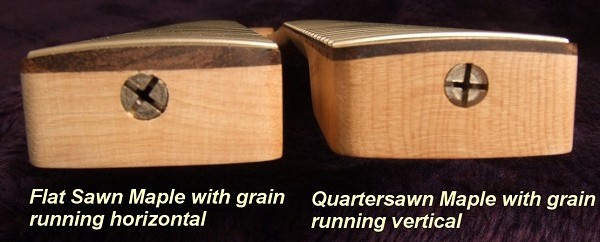
Nearly all production necks today are made from what is known as flat sawn lumber. I am not a wood expert, but essentially there is a greater yield of flat sawn lumber for necks when cutting up a tree. Greater yield means lower cost. How do you know if your neck is flat sawn? On a bolt-on maple neck guitar the easiest way to check is to look at the end of the neck where it butts up against the neck pocket. If the grain of the wood is parallel to the fingerboard, it’s flat sawn. The picture below is courtesy of Alberto Bolocan’s blog — or at least he used it too —  and Alberto has some very detailed information on the various sawing techniques.

As you can see, the quarter sawn neck has the grain of the wood perpendicular to the fingerboard.  Having the grain of the wood perpendicular to fingerboard results in a measurably stiffer neck. As you can imagine, bending a piece of wood with the grain is much easier than bending a piece of wood perpendicular or “against” the grain. The density of the quarter sawn lumber is sometimes higher too, also contributing to greater stiffness.

So you can expect a quarter sawn neck to be stiffer, and affected less by changes in weather. This is especially handy with bass guitars and their longer necks, or with guitarists that like to use heavier gauge strings. I find that when setting up a quarter sawn neck that they are naturally very flat, and sometimes it’s hard to get enough relief (bow) out of the neck. Changing up or down a gauge on strings will likely have no effect on a quarter sawn neck.

Quarter sawn necks are also felt to be brighter and more responsive than a flat sawn neck. This is due both to the increased stiffness of the neck and the higher density of the wood. I would generally agree with this observation, although it’s hard to make direct comparisons without actually changing necks on the same guitar. In general though quick attack and good note clarity are characteristic of a quarter sawn neck.

As a side benefit, the grain pattern of the headstock looks really neat when quarter sawn, especially with a vintage tint.

So is quarter sawn worth the money? This option typically adds about $75 to the price of a G&L, so for most people it’s not a deal breaker. If you tour, or live in an area with wide swings in temperature or humidity, a quarter sawn neck is absolutely more stable and will require fewer adjustments. The sonic differences are not dramatic, but if your preference run towards a snappy instrument with a solid attack it certainly cannot hurt. We recently received a custom order guitar — Classic Custom Semi Hollow — with a flame maple top and quarter sawn maple neck. The combination of reflective maple top and stiff neck resulted in a remarkably clean and detailed sound that really projected unlike a garden variety ASAT.

Whether it’s freedom from occasional adjustments or the desire for a more responsive instrument, a quarter sawn neck is a low cost option with obvious benefits.

Fender: 25 Years at the Ensenada Factory

We sometimes like to take pleasure in kicking the big guys when they are down. GM, Goldman Sachs, Microsoft…the Yankees. Seeing the seemingly invincible struggle sometimes makes us little guys feel better. In the world of guitars, certainly the two electric heavyweights Fender and Gibson have had their share of troubles. Fender has been in headlines for their struggling profitability and the much publicized IPO that never happened (probably because the Private Equity people realized that the stock value just wasn’t there). Gibson of course hit the papers with their government raid and fines related to the improper importation of restricted hardwoods. I still maintain that if everyone else in the industry can manage to buy fingerboards legally, then Gibson most likely was doing something not kosher. Also there’s just something about a $3500 guitar with lacquer drips, but that’s for another day.

Fender however recently hit a real milestone with the 25th anniversary of their manufacturing facility in Ensenada, Mexico. What is so great you say about celebrating a factory that makes guitars in Mexico rather than in the USA? The importance of the Fender Ensenada factory is that over two decades ago Fender realized that as global competition would continue to drive manufacturing to low cost countries, that is was better to control their destiny rather than subcontract it. The Fender factory in Mexico now employs over 1000 people and occupies over a quarter million square feet, turning out electric guitars, acoustics, and amplifiers.

It would be nice to think that this manufacturing could have stayed in the US, but by nature guitar making is labor intensive. And with 80% of the worlds guitar market being under $600, nearly all this market is going to be fulfilled by suppliers in low cost countries. In a recent Music Trades article about the Fender plant, it was pointed out that in 1990 China produced 0% of the world’s guitars. Now China produces over 70% of the world’s guitars, but only 45% of the total market value. In other words, they make a boatload of inexpensive guitars. And most of these China factories don’t have names that we would recognize. They are contract manufacturers that produce guitars and then brand them with names that we do recognize. This is how much of the consumer product world works, but it’s hardly the image we like to have of guitar making as a craft.

Fender deserves a lot of credit for investing to maintain control over their intellectual property, their manufacturing processes, designs, materials and product quality. Building a factory is a huge undertaking, and it would have been much less expensive for Fender to just find a factory to build their designs. However, when we stop manufacturing, we also lose touch with the skills and technology to actually create the product. Product designers who know how their designs are made invariably design better products. Take a guitar pickup for example: Here is a product where several companies can take the same wire, magnets and bobbins but all get different results. It’s the process of making the pickup as much as it is the actual design. When manufacturers and designers work together, products and quality naturally improve at a faster rate. The pace of product development increases too, and it takes less time to bring a new product to market. Although the factory is in Mexico, it’s a day trip from the Fender HQ in Arizona. They are in the same time zone and the same continent, and it makes a difference.

As a lot of people already know and appreciate, a “MIM” (Made in Mexico) Fender is a good quality product. It’s not a cheap guitar; it’s a guitar that delivers top value for the price point. As the factory continues to increase its capabilities, the price point and value of the MIM products  will continue to rise. From the standpoint of brand equity, the Fender MIM products are largely embraced by the guitar playing public, and while some would rather be playing a true USA Fender, nobody is being done a disservice by playing an Ensenada product.

Whether it is Foxconn producing the iPad or whoever actually makes Nike footwear, there is increasing separation between the creators of products and the manufacturers of the products. Some pundits will argue that owning the design is the only true value, and that manufacturing is strictly a matter of finding the lowest cost source. That’s how we get Barbie Dolls with lead paint, and why it’s hard to buy a Toaster Oven that will last more than three years. Guitars are not appliances or toys, and should not be built that way.

Fender has its share of troubles, and for some purists the only real Fender guitars are those made before 1965 when a man named Leo ran the company. But for people of normal means, Fender Ensenada products are the pathway to owning what are arguably the most recognizable shapes in rock and roll. Kudos to Fender for keeping the dream of rock and roll alive.

Where are the good rock radio stations?

If you’re like me, you still listen to a fair amount of radio. For me these days, it’s mostly news via Public Radio, but I still attempt to discover new music by listening to the radio. With radio stations so tightly formatted to a certain genre, it’s quite a chore. Also radio ownership is highly concentrated these days, which leads to musical conformity and homogenized playlists. A quick check on Wikipedia showed that just three companies own more that 1600 stations across the US. Check it out here:

http://en.wikipedia.org/wiki/Category:Radio_stations_in_the_United_States_by_owner

This is why the FCC is supposed to limit things like concentrated ownership of radio, TV and newspapers within a given media market. Yeah, right.

But, all is not lost. Between independently owned and college stations, you can still find new music created by new bands, old favorites, and artists that fell off the charts years ago but still ply their trade with integrity.  So I’m going to try an experiment here: If you know of a good radio station that plays a wide variety of new and old rock, blues, R&B….and they stream over the internet, send me an email with the link and I’ll post it here. Just send it to sales@upfrontguitars.com and I will put the link on this blog page. Half the fun of music is hearing new music. So let’s start a movement for good radio and spread the word. Here is my first submission:

WXRV “The River” in Haverill, MA: www.wxrv.com


Will Country Music Save the Electric Guitar?

If you’re a person of a certain age — let’s say over 35 — your definition of rock music is probably very different than somebody who is currently in high school or college. For the first forty years of rock music, the primary driving force was the electric guitar. From Scotty Moore backing up Elvis in the 50’s to Kurt Kobain in the 90’s the electric guitar was inseparable from the music.

But as rap, hip hop, house music and the generic category of dance pop came to dominate what was left of Top 40 radio, electric guitar and the guitarist started to fade into the background. In the realm of pop music, how easily can you name current popular figures that are known for playing guitar? Unless you are into really hard rock, metal, or ply the pages of Guitar Player it’s not easy to come up with many names. John Mayer perhaps, Dave Grolsch (sort of) but in general it’s a short list. Now of course you might do better if we include College Radio or Adult Contemporary, but in the world of Pop it’s pretty slim pickings.

Go back to any decade, and rock on the radio just oozed guitar. You name it: Chuck Berry, Beatles, Stones, Hendrix, Deep Purple, Steely Dan, Lynyrd Skynyrd, Bon Jovi, Aerosmith, Doobie Brothers, Def Leppard, Pearl Jam, Van Halen….you name it. I’m not even touching on the whole Hair Metal era which essentially revolved around pointy guitars and spandex.

Not all of this was great music, but it all featured guitar, and kids who listened to this music wanted to play guitar. What do they want to play today? Their Laptop? When a lot of today’s music can be sampled, programmed, or mashed, creating music may not involve playing an instrument at all.

For certain, I’m sounding like an old man right now, but this can’t really be good for guitar companies. If the music young people are listening to doesn’t inspire them to play guitar — or they don’t even hear a guitar — guitar sales are going to suffer. It’s not news that companies like Fender and Gibson are struggling, and while some of this is obviously related to the economy, popular music is less guitar driven than it used to be.

Which brings us to the potential savior of the Electric Guitar: Country Music. Go ahead and laugh, but if you want to hear a half-decent electric guitar player on pop radio these days, chances are it’s going to be in a country band. Country music has largely taken the place of rock music on Pop radio, and as it evolves it becomes increasingly less country and more like just like rock. Take away the vapid lyrics about dirt roads, beer and cut-off jeans and bands like Rascal Flats and Jason Aldean are churning out arena rock just like the old days. If you go back a decade or so, producer Mutt Lang (AC/DC’s, Def Leppard) practically created the genre of arena country with his then-wife Shania Twain and her blockbuster album Come on Over.

Country music even has its own guitar heroes. Guys like Brad Paisley and Keith Urban manage to be both really hot players and popular music figures. And in general, some of the most talented bands in popular music are the country bands. Say what you will about the actual star performer, but the bands backing these singers are sharp as a tack. And if you check out their gear you’ll see some interesting stuff: PRS, Mesa, Victoria, Marshall, and of course Brad and his Dr. Z’s. It’s a far cry from the Tele’s and Tweed that defined country music for years.

So if Country Music is the current curator and preserver of electric guitar, should we be concerned? If actual people are playing real guitars in real bands with other instruments but it also happens to be country music, do we look down in scorn? If you feel that way, take some Brent Mason, Vince Gill or Albert Lee and call me in the morning. Talent runs very deep in country music; it’s just that like most forms of music it gets processed and homogenized for popular consumption, often ending up like musical equivalent of Twinkies.

There are quite a few things that bug me about country music, such as the beer-and-wings lyrics, lack of tempo change, and such glossy production that any real energy is often sucked out of the song. But imitation is the sincerest form of flattery, and what you have these days is a winning formula, with dozens of also-rans capitalizing on a trend. That’s not so different from any phase, whether it’s the British Invasion or Disco. There are always the creators and imitators. So while much of what is on country radio these days sounds totally packaged and phoned-in, that been true since to dawn of pop music.

I’m not trying to convince anyone to become a country music fan, and it’s certainly not my favorite format. But within any category of music there is true talent, and our job as music lovers is to look past what the “industry” is trying to sell us, and dig deeper to find the people that are truly making music. Country music is a big tent that runs from the traditional to essentially today’s version of pop-rock. In many ways it’s keeping the electric guitar in mainstream music, and if only for that, we rockers need to at least give it a deeper listen.


American Made Electric Guitars for around $1000

Updated January, 2016

The solid body electric guitar is a uniquely American invention, but as most people know, very few of them are made in the USA anymore. As with many consumer products, the lure of low cost labor has drawn most manufacturing offshore. The first imports in the 60’s were from Japan, and then as costs rose there, manufacturing shifted to South Korea, then China, and now there is a growing industry in Indonesia. China is still the big dog in terms of guitar production, but as Chinese manufacturing costs continue to increase, more manufacturing will likely shift to Indonesia, and after that, who knows where?  Most players would be surprised to learn that South Korea accounts for only about 5% of electric guitar production, with the USA a couple points below that.

In practical terms, the average guitar player benefits from lower prices for musical instruments and gear. Given the combination of low labor costs and improved manufacturing technology, the bang-for-the-buck on guitars has never been better. About 44% of electric guitars purchased in 2011 cost less than $200. That’s just an astounding number, and even more astounding when you figure that these products are generally something you can actually play and that will stay in tune. Fully 80% of electric guitars purchased in 2011 cost less than $600. While I can’t be certain, I’ll wager that virtually none of these guitars were manufactured in the USA.

But what if you want to purchase something made in the USA, and you are on a budget? There are several options available, and if you are willing to head north of the border, the selection expands considerably. This is not meant to be a totally comprehensive list, but just some of the options out there for guitarists that want a good quality instrument and also support American manufacturing.

G&L – Barring a special release model, the days of a $1000 street price G&L are over. With new dealer and list pricing implemented in July 2015, your not going to see a 2015 G&L at this price; short of a desperate and/or math-challenged dealer blowing them out. There are still quite a few new 2014 models out there, and a base Legacy or SC-2 still might be had for around a grand. G&L continues to offer a unique value in terms of fit, finish, and the ability to special order. If you are willing to stretch your budget, you will be well rewarded.

Godin – Godin gets an honorable mention because while they don’t manufacture complete guitars in the USA, they assemble a variety of models in their New Hampshire facility from Canadian-made parts. Godin also uses a lot of locally sourced and sustainable woods like Maple, Basswood, and Cherry for their guitars. The Session and Progression and Core lines are examples of guitars assembled in the USA, and with a street price of around $500 the Session is a particularly good value. If you consider Canada as the 51st state, the all-Canadian Godin Core is our favorite both in P-90 and Humbucker trim. These street price for around $800, and there is just nothing not to like about them. They even use Seymour Duncan P-90 and bridge Humbucker pickups. Now for a $500 North American guitar don’t expect vintage Alnico pickups, and Godin does use PCB-mounted controls rather than hand-wired pots, but the setup and playability are first rate. All Godin guitars included a gig bag in the price.

Fender – One thing is for certain about Fender, and it’s that they offer a dizzying array of products that is both extensive, confusing, and often unnecessary.  But mixed in there is an assortment of Highway One and American Special guitars that offer good values and prices right at around $1000. Models seem to come and go in the Fender line with little or no warning, so what’s available at any given moment is hard to predict. The pickups in these guitars are decent if not awe inspiring, but overall these guitars are perfectly gig-worthy instruments and great platforms for hot-rodding. Keep in mind the price of these guitars either include no case, or a gig bag.

Gibson – Like Fender, Gibson suffers somewhat from product line schizophrenia. If you are browsing the major online retailers, models tend to come and go, at least from a standpoint of what’s being promoted at the moment. Gibson offers “faded” Les Paul and SG models with prices below $1000. There are also satin finish guitars both with flat and carved tops that come in under $1000. Gibson also offers Melody Maker and Les Paul Junior models, again with satin or aged finishes. We’ve tried the Les Paul Junior, and it’s pretty nifty with lots of bite out of the single dog-ear P-90, and good playing qualities. LP Juniors are fun guitars, and for a for pure elemental rock machine you can’t really go wrong. Gibson fit and finish can sometimes be a little variable, and if you want to mod the pickups or controls, you’ll likely be dealing with a printed circuit board (even if you spend thousands). As with Fender, gig bags may not be in the price, so consider that when you are shopping.

Carvin – By eliminating the retailer and going strictly direct, Carvin has been putting out a broad variety of attractively priced USA guitars for many years. Having never played their guitars I can’t say a wh0le lot, but my personal experience with their pro-audio and bass amplifiers tells me that they do deliver above average performance at a very competitive price. Provided you don’t option them up too much, their ST300, DC127, DC134/5, DC600 and Bolt-On  series guitars can all be had for under $1000. Carvin guitars can be custom built to order, and the array of options available from Carvin is pretty mind-boggling. For under $1000, your going to be looking at a fairly basic guitar — no quilt maple tops or Koa wood — but there is still a lot to choose from. Part of the option list is the case, and essentially you have to buy some sort of case, but the case pricing is very reasonable.

Summary – There is a good feeling about buying something made in the USA, and supporting American manufacturing. After all, the solid body electric guitar was born here, so why not buy one made in the USA? In this global world, made in USA is also subject to interpretation. For many product categories there are specific regulations that control whether a product can be labeled “made in USA” or “assembled in USA” etc. There is likely some amount of foreign content in any USA guitar, most notably electronic components, and of course certain woods like rosewood just don’t exist in the USA. Also, chances of finding a gig bag not made in China is pretty tough. So made in USA can sometimes be a fuzzy term, and certain components just cannot be sourced domestically. With that in mind, you can find a guitar in which the majority of the parts and labor come from domestic sources, and not break the bank doing so.

To see some of the American made guitars carried by UpFront Guitars for around $500 – $1200: www.upfrontguitars.com


The Guitar Pedal Boom – Too much of a good thing?

As anyone who is even a casual player has noticed, the last few years have been truly explosive for the guitar effects market. The rise of stomp box mania has defied current economics trends — sales even grew during the recession —  and is now over a $60 million segment of the MI industry. The number of brands and selection is dizzying, and just browsing one particular online guitar website revealed that they carried over 120 brands!

Why are pedals so popular?

Well for starters, as far as guitar gear goes, pedals are cheap thrills. With the vast majority of pedals being priced under $150, it’s not a big investment to try out a pedal, and if it’s not the cat’s pajamas you can sell it to a friend, put it on the shelf, or stick it on eBay. To some degree it’s pretty hard to wear out a pedal, so a used one on eBay is typically a smart choice. I have a theory that pedals are like the proverbial Christmas Fruitcake; there is actually only one, and everybody just keeps passing the same one around.

For a budding manufacturing or mad scientist, going into the pedal business has a fairly low barrier to entry. Practically everyone uses the same die cast box — now that guy is making a killing — silk screening and painting is pretty low tech (some people even skip the paint) and the actual cost of the components are pretty low too. If you don’t mind hand soldering, there is no need for fancy assembly or wave soldering equipment. It’s also pretty easy to find schematics online, or just back engineer your favorite stomp box. Now there are obviously many serious companies out there doing lot’s of research and making significant investments in R&D and manufacturing. But for somebody who just wants to get into the business, it’s a lot easier than making guitars, amps, or speakers.

One other factor — at least to me anyway — is that if you are looking for great sounding distortion or gain, which is by far the most popular effect type, a pedal is quite often better sounding than most “gain” channels on two or three channel amps. There are many players out there with multichannel amplifiers that tend to play only the clean channel, and rely on pedals for distortion and modulation effects. Why is this so?

Well if you look back to the early amplifiers and the onset of distortion, the distortion was caused by the power tubes clipping, which turned out to sound really good; warm, sweet and very musical. A low powered amplifier with limited headroom such as a Fender Tweed would distort at a reasonable volume level. It sounded great, and everyone saved their hearing. But bands were playing ever larger venues and needed larger amplifiers, with more wattage, and more headroom. Now the amps were louder, which was good, but that warm power tube clipping was gone. Try and get a Fender Twin to distort, I dare you. Players needed volume and distortion that they could control.

But some clever engineers came of with the master volume control. This allowed the player to essentially overdrive a section of the amplifier, but control the overall volume level with the master volume. Presto! distortion at listenable levels. But the characteristic of the distortion was different. It was not warm and creamy but more harsh and fizzy. This is the because the distortion is produced by clipping the preamp tubes, and this distorted sound is then fed into the power tube section for amplification. It’s a sound, but not the sound of an amp being played at the limits of its clean headroom.

Early master volume amplifiers were often harsh and raspy, with an edgy tone that was anything but musical. Fender’s foray with master volume controls in their 70’s Silverface amps were vile, sounding somewhat like a Kazoo Orchestra playing Smoke On The Water. Obviously amplifier designers have gotten much better in producing musical overdriven sounds, typically still by using preamp distortion. The famous Mesa high gain sound is essentially multiple preamp tubes each over-driving the other to produce a thick chunky distortion tone. This is sometimes called cascading gain, and it can sound really good. If you’re a fan of metal, it’s where it’s at.

But this type of distortion is actually fairly easy to emulate using solid state components. It’s not so easy to make a pedal that really sounds like a small amp working hard on a Saturday night, but fuzz and higher gain distortion sounds can be quite convincingly created in a small metal box. It looks a hell of a lot more impressive to have a half stack, but a 1×12 or 2×12 combo with good headroom and a couple pedals can sound pretty mean.

My apologies for a highly compressed and somewhat biased view of amplifier history, but many players have found that an amplifier with a good sounding clean channel is the perfect “canvas” to paint on with the pedal of your choice. Often a well-crafted little box will sound better than an amplifier using preamp distortion to achieve high gain sounds. That’s my experience anyway, and my choice in selecting an amplifier is totally focused on finding the best natural tone possible, and using pedals to color the sound in a way that suits my musical leanings. I also happen to like a little “natural” tube grit to my tone, so I tend to play fairly low powered amplifiers, but even so I’m never going to turn my amp up to “10” for a solo. I’ll use a pedal. As far as I can tell, the only people who turn their amps up to “10” are on YouTube, and live in very small bedrooms.

So pedals are inexpensive, they are plentiful both new and used, and the low investment required to get in pedal business means that lots of people are making them. So it’s all good, right? Sure, there is nothing essentially wrong with having too much of a good thing, and over time the number of pedal makers will reach some sort of natural Darwinian limit: The really good builders with grow and thrive, and the hacks and pure copycats will fade away. I’m of the opinion that pedals are somewhat like pizza: None of it is truly bad, and everyone finds their favorite. There are however many bad amplifiers, and spending $300 on some boutique distortion pedal with rare germanium diodes will not hide the fact that your amp sounds like crap. Start with the amplifier and speakers first. Get your core sound down to where you really love what you hear with nothing more than a guitar, a good cable, and your amp. Then go forth and experiment with the little die cast boxes of your choice.


The Fender Bassman Amplifier – The amp for almost everything?

Preface: Never say on the internet that anything is ever the “best” or you will be hounded by email, gear pages will convulse with derision, and internet servers will glow incandescently straining to handle the volume of traffic proclaiming your incorrectness. So in this post I will completely avoid the term “best’ and merely relate one’s own experience with a particular amplifier.

This story started several months back when my brother Neil called up and said “Hey, I found this really nice amp, you want to go in halves with me?” It seems that our friend Dan Neafsey of DGN guitars had acquired a Fender Bassman Ltd in a trade and wanted to sell it. This is the “nice” reissue of the Bassman with a pine cabinet, GZ34 rectifier and (4) Jensen ALNICO 10″ speakers. It’s very much like the original Fender 5F6 schematic except of course for the printed circuit board, non-carcinogenic capacitors and a 3-prong plug. And it doesn’t cost eight grand. On top of that, it’s a rare “relic” version with some nice mild aging to the tweed, and some faux cigarette burns on the topside. Some find the whole relic thing pretty cheesy, but it looked good and the aging was tastefully restrained. Lastly, Dan had ditched the circuit board and done a point-to-point Mojo Guitar Works conversion with some nice high grade components. So not wanting to turn down a brother in need, I sent him some bucks via PayPal and the deal was done.

At this point I should say that my brother lives about 130 miles away, so half ownership is kind of like joint custody: When do I get to see it, how often, and what about weekend visits? However, Neil also does most of the major work on my car. As luck would have it, it was time for a new timing belt and I headed off to Connecticut with my car and a DGN Tele®.

There are a couple guitar players at the repair shop where my brother works, so there is usually some gear hanging about the garage. They literally have a garage band. Shortly after arrival, my car was on a lift in one bay, and in the other bay was the Bassman warming up, along with a LP Junior, the Tele and a couple pedals.

The garage is a high-bay affair with decent acoustics, and any amp tends to sound pretty big in there. But the Bassman was just on another level. Diving in with the Tele, the Bassman had a wonderful combination of slightly spongy twang, deep full bass, and a room-filling presence that made a typical 1×12 combo sound strangled and puny. This puppy really breathed; and the interaction of some rectifier sag and four little speakers huffing and puffing in a pine box created a connection between guitar and amp that was more mechanical than electrical. Each note had a beginning, middle and end that was totally musical, with a broad projection and sense of texture that you could almost reach out and grab. Open tunings and drop D on the Tele created shivers and silly grins all around. I was hooked.

As I drove back I realized that our mutually arranged weekend visits with Bassman would not do. But what now? There are not any shops around me with cool gear — except maybe mine and I sure didn’t have one — and I was not going hit up Guitar Center hoping to get lucky. So with few other options it was off to the “Magic Devaluator” of all merchandise: eBay. I got lucky almost instantly, and there were three used Bassman Ltd’s with the right specifications all bidding in the $700 – $900 range. So for a little over $800 shipped I got a very clean Bassman Ltd with a couple light scuffs, mint condition cover, and even the glossy cardboard piece they put over the top with the all the sales promo stuff and suggested amp settings. From what I can tell, it’s not really used at all. To finance this, I sold my real ’67 Pro Reverb for close to twice that and came out ahead on the deal, sonically and financially.

Whenever I get a new amp, the first thing I try to do is make it “better”. I hauled out some NOS tubes — Bugle Boys, GE’s, RCA blackplates —  talked to my brother about what he experimented with, and so forth. The amp came with the original Groove Tube/Fender tubes including the USA-made Groove Tube 6L6 ‘s. However, except for substituting one of my NOS 5V4 rectifier tubes that I got from KOS (oddly, rectifier tubes do sound different), nothing really sounded better than the original tubes. Clearly the Jensen speakers sounded great, so I was not going to touch them (plus Neil already tried that and said don’t bother).  Fender had done their homework: The Bassman really needed nothing, and any effort to improve it’s sound took it the wrong direction. Lesson learned.

I experienced a similar phenomena with whatever guitar I plugged into it: The tone was good off the bat, with very little tweaking of the knobs. I tried a lot of guitars: Les Paul’s, an Archtop, various G&L’s, a Rickenbacker, and even a Godin Multiac Nylon string. No matter the guitar, it was never a total “do over” with the EQ. Just maybe a slight tweak of the bass or treble and I was off and running. I would have never imagined bringing my G&L and a Rickenbacker to the same gig, but with the Bassman it might just work. And I’m just talking EQ: I have not even mentioned that the Bassman has a bright and normal channel,  each with hi and lo inputs, and you can jumper the inputs to use both channels at once.

I was flabbergasted: All these years I have been messing around with amplifiers, and it never once occurred to me to try a Tweed Bassman. Now I wonder why they aren’t more popular. To some degree the great popularity and legend of the Blackface amplifiers led me to believe that this style of amp was the holy grail of tone. After trying and failing with a few real Blackface Fenders, I discovered in a roundabout way via a ValveTrain Trenton that the Tweed tone really suited my style. Between the Bassman and my Dr. Z Remedy, I’ve pretty much got things covered. Which I guess means that I’m really a Marshall fan because the Remedy is based loosely on a Plexi (but with 6V6 tubes) and the Bassman is the basis for the JTM45. My whole amplifier belief system has been upended by the Bassman.

There may be some perfectly good reasons not to want a Tweed 5F6 style Bassman. You might find that an amp that looks like a big brown suitcase is the wrong look for you, your band, or your peers. I suggest you get over that one, and just have them listen to it or look the other way. Or, that a 4×10 amp is too heavy and bulky. The amp is a little boxy, but the pine cabinet and ANILCO speakers keep the weight down to around 50 pounds, which is way less than any tube 2×12, and even some tube 1×12 combos (If size and weight are truly major concerns, check out the ValveTrain Trenton for a  vibe that’s close, but in a smaller package). You might also be rightly concerned that a Tweed design amp won’t handle pedals or high gain very well. While this is generally accurate of the Tweed genre, the Bassman was intended to handle a bass guitar signal, and therefore does have pretty good headroom, and it’s 50 watts. I find it works pretty darn good with pedals, although if truly high gain rock/metal is your thing, then you will look silly playing a Bassman, and you are free to purchase the large ominous-looking black box of your choice. But if your styles include blues, roots, indie and a good dollop hard driving rock — think  JTM45 — there is no reason a Bassman and a couple well chosen pedals won’t get you there in style, and at reasonable volume levels, and set you back less than a grand. Plus you can finally bring your Rickenbacker to the gig.

Guitar Tweaks: Can you hear the difference?

We’re talking about tweaking your guitars and your amps. You know:  Stuff, gear, tweaks; can you hear the difference?  Once the drummer fires up, does it really matter that you specifically tweaked your pickups, capacitors, pots and speakers? Does it matter to you or to the audience (should you have one) or do you do it just because you love to experiment?

What have you tried?  What can you hear?  What’s for real? The Internet is full of stuff to buy and try.  Some with disputed results, some not.  Some is must have, or at least must try.

For starters, let’s takes strings.  Strings make a real difference in your sound.  Steel, Nickel, Nickel over steel, Nickel over Nickel.  How about even Nickel over round core versus a hex core? It is pretty much undisputed that different strings sound different.  Most people won’t argue that strings make a difference.

The next topic is  Guitar electronics as in “Caps and Pots”.   You commonly hear “was like taking a blanket off my amp”.  Yup a nice old (or new) PIO (paper in oil) cap can really smooth out and open up a dark or muddy guitar.  Some of the “chicklet” caps in today’s guitars are very harsh.   And it all depends on the value of the cap.  .015 is really nice in a LP with a Humbucker in the neck.  Tame a shrill bridge pickup with a .047 in the bridge.  Most guitars, LP’s anyway come with .022’s.  There are a lot of variables here and again most will agree “pots and caps” make a difference because they do.

Pickups: Way to big a field to even start to discuss here.   I’ve tried a bunch.  I’ve heard large changes, not always what I wanted and I’ve found after some installations I can barely hear any difference at all.   It’s nobody’s fault; the whole idea of describing sound is rather vague anyway.  But in general shop wisely and have an idea of what you want, and then pickups are a good solid upgrade.  I’ll throw out a generalization, and that is go for pickups with less output than you think you want.  Pickups wound really hot choke off highs you may want later.  Get the tone out of the guitar and tailor it at the amp.  Also pickup output can be increased with larger magnets as well as windings.  Difference is the larger magnets don’t choke highs like windings. You can also split hairs by changing magnets in the pickups you already have, but that may be getting too OCD for some.

As with pickups, speakers are a huge topic and they can make or break your sound.  Everyone likes something else.  And remember what sounds great alone in practice situations may not sound great in a band setting. Loud alone isn’t the same as loud with a drummer.   This is why I like heads and separate speaker cabs.  Mix and match.  Makes for more options.  So let’s put speakers into the category of yes, makes a difference.  Yes we heard the difference.

So many more things you can change.  Everything matters.  The room you play in matters.  How far is your open back amp from the wall at home vs a practice or gig?   Your amp, your tubes, your tube bias………  Even the pick you use makes a difference.  This is an area where naming all the stuff that matters can’t really be tackled in one blog.  But it is stuff we mostly all agree we can hear, and that it matters.  We want our base tone to be as good as it can be.  If we can hear it, then it was worth it.

So why is it that the web is full of players who argue that you can’t hear the difference in cables?  They say the cable from the guitar to the amp can’t make any difference, and any difference heard is because you just paid a lot for a cable.  It’s all snake oil and pseudo-science, right? Nope, I’m here to say that it matters much more than you think.

A year ago I was at UFG (Upfront Guitars) world headquarters to try some stuff.  I had a nice Gibson R4, my groovy little true PTP wired boutique amp armed with nice old tubes and we’re rockin’ out.  We were trying different cables.  I was playing a solid core cable versus my OK mid-priced name brand stranded cable.  Yes there was a difference.  More clarity, more shimmer (here we go, trying to find words to describe tone) from the solid than from stranded, and less distortion.  Then I tried a coil cable.  I have a tendency to make any straight cable turn itself into a knotted mess in minutes.  I had hopes that the coil cable sounded good.  If it did I was getting it.  It was as clear as day that the coil cable was the worst cable we tried.  Worse than a straight stranded cable.  Worse than my daily cable. No doubt, no question, it was dull, dark, and fuzzy.  No point in debating it, and not close to the solid cable

A real eye (ear) opener was when I did a blind test.  This was not planned but it worked out that way.  I had been playing just guitar with solid core cable into the amp.  Played some chords, riffs, all the stuff you play when you are trying gear out.  Then I added a couple of pedals into my signal chain.  These are good pedals with true bypass, they were all off and I used stranded cable between them and to the amp.  I started playing again.  The other guy in the room whose back had been to me all this time said right away “wow, what did you change?”  All I’d done was add some stranded cable to my signal chain.  The clarity was different, a little more muffled, a little less “shimmer” Also I found that what I had thought was attack-driven dirt when I played harder was actually distortion from the stranded cable and not from me hitting the amp harder. Swapping in solid core cables cleaned up the signal and the distortion was gone. I now have solid cable in my board and the whole signal chain, but I’ll agree that good stranded cable is very close to solid cable.  I’m just looking for a clean signal.  I can wreak havoc later with a pedal, right?

Yes Hendrix liked the sound of a 50’ coiled chord from Radio Shack.  There is also a guy on Youtube with fantastic demos of his ’59 LP and Trainwreck amp.   He likes the sound of a very long (100’?) cable in his signal chain.  He likes what it does for his tone.  His tone BTW is freakin’ awesome.  You may also like either of the above.  You gonna tell Jimi his sound was crap, to get another cable?  He knew what he was doing.  A cable is a tone control.  Don’t ignore it.

I guess I feel like I owe it to myself to get things right. I just want the cleanest purest signal from my guitar to the amp or pedal.  I know that once the band starts up, once the drummer shows up late and starts his noise in the room with the low ceiling and the wall of mirrors across the dance floor you may feel all is lost.  But you gotta have a good thing going in right?   If you can hear it, it will have an impact on your playing. And you can hear it.

 – Neil Swanson